The Global Lingua Franca
“The vast majority of verbal exchanges in English do not involve any native speakers of the language at all.”
Barbara Seidlhofer (2005). Understanding English as a lingua franca.
“ELF [English as a Lingua Franca] is intersubjectively constructed in each specific context of interaction…negotiated by each set of speakers for their purposes.”
Suresh Canagaraja (2007). Lingua Franca English, Multilingual Communities and language Acquisition. The Modern Language Journal 91. 923-939

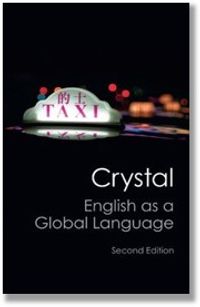 | “Grammar and vocabulary are not the only domains within which linguistic distinctiveness manifests itself among the New Englishes of the world: pragmatic and discoursal domains also need to be taken into account.” David Crystal (2003). English as a Global Language. 2nd ed., p. 168 |
 | “One would be deceived to restrict problems of English as a lingua franca only to phonetics, syntax, lexicon, and discourse patterns. The cognitive-sociolinguistic and cultural linguistic approaches (…) to World Englishes are ideal to systematically describe cultural conceptualizations realized in the different varieties of English. These approaches can thus make an important contribution to the study of intercultural communication and pedagogic approaches to intercultural competence.” Hans-Georg Wolf (2015). Language and Culture in Intercultural Communication. In: Farzad Sharifian (ed.)(2015). The Routledge Handbook of Language and Culture. p. 451 |
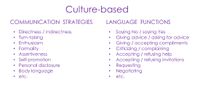 |
CLICK on the image to enlarge it. |
e.g. INDIRECTNESS |  |
"Changes in proficiency norms have seen the gradual shift away from the Native Speaker as the ideal to a more nuanced and locally or regionally appropriate model." Mina Patel, Mike Solly, Steve Copeland (2023). The Future of English. Global Perspectives. p.278 To download your free copy of this study published by British Council CLICK on the picture. |  |