AI & English as a Lingua Franca
 | Language is the cornerstone of human intelligence. |
"The effectiveness of AI in enhancing intercultural communicative competence is also influenced by the quality of the data on which AI algorithms are trained. If the data used to train AI models are biased or lack diversity, the AI's ability to accurately reflect and respect cultural differences may be compromised. This is particularly concerning given the potential for AI to reinforce existing stereotypes and biases if not correctly managed." https://www.degruyterbrill.com/document/doi/10.1515/applirev-2024-0186/html?utm_source=copilot.com |  |
What kind of "Englishes" can AI potentially model? | |
Written Production | |
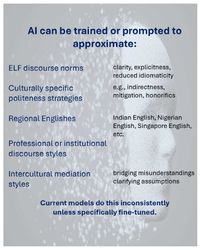 | "There is an intensifying awareness that we need to develop more culturally-sensitive, and interactionally-competent AI conversational agents […] From here we can identify, for example, better prompting techniques to help AI reduce biases and stereotypes." https://www.degruyterbrill.com/document/doi/10.1515/applirev-2024-0186/html?utm_source=copilot.com |
Oral Production | |
"One of the most significant challenges is AI's difficulty in understanding and conveying cultural nuances. Communication is not merely about exchanging words; it involves tone, context, non-verbal cues, and deeply embedded cultural meanings. Khasawneh (2023) points out that AI's limitations can lead to misunderstandings and misinterpretations, particularly in more complex communication scenarios." Farina & Lavazza (2025) warn that LLMs may reinforce a standardized, homogenized English, unless they are deliberately designed to preserve linguistic diversity. This is crucial: it means AI can adapt, but only if trained with that goal." |  |