Teaching English as a Lingua Franca
A first approach:
As an introduction, we recommend this free self-study course designed by the British Council and York St John University in 2013 and updated and revised in 2023.
|  |
CONTEXT-SPECIFIC COMPETENCES: | |
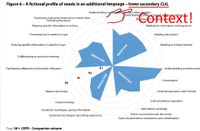 The CEFR-Companion Volume provides detailed Can-Do descriptors for PLURILINGUAL, PLURICULTURAL a.o. relevant skills. These can be helpful when specifying learning needs in great detail. | "The reason the CEFR includes so many descriptor scales is to encourage users to develop differentiated profiles. Descriptor scales can be used firstly to identify which language activities are relevant for a particular group of learners and, secondly, to establish which level those learners need to achieve in those activities in order to accomplish their goals. [...] Profiles like Figures 6 and 7 may be produced for individuals in the context of very intensive LSP training, but the technique is also very useful for analysing the needs of particular groups of learners." Council of Europe (2020). CEFR-Companion Volume. p. 38 EVOLUTION - NOT REVOLUTION! |
"In practical terms, the best approach to introducing a curriculum geared to the goals and aims of plurilingual and intercultural education (…) should be one of gradual medium- or long-term development and not break sharply with the existing situation. Looking closely at the existing curriculum is an essential first step if the approach adopted is not 'all or nothing' but 'little by little'...” |  |
Choosing teaching material: | |
 Zia Tajeddin, Hossein Ali Manzouri (2025). Teaching Materials in English as an International Language. Research and principles. in: Ali Fuad Selvi, Nicola Galloway (eds.) (2025). The Routledge Handbook of Teaching English as an International Language. p. 174 | 1. Ask |
Five Principles of the Lingua Franca Approach: | |
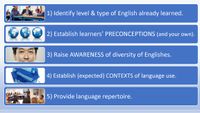
 | 1) The native speaker of English is not the linguistic target. Mutual intelligibility is the goal. Andy Kirkpatrick / Wang Lixung (2020). Is English an Asian Language? p. 189 |
 |